OBS Report: Geopolitical scenarios and trends that will change the world in 2026
The United States sets out to reconquer the markets
- Today, the world is divided into two opposing economic models: one ultra-liberal, with the US as its leading exponent, and the other interventionist, with Russia and China.
- The United States has lost its position of hegemony to China, which is the preferred trading partner of most countries on Earth. Donald Trump feels threatened and will fight to regain it at any cost.
March 2026. OBS Business School, part of the Planeta Formación y Universidades higher education network, publishes the report Geopolitical scenarios and trends that will change the world in 2026, led by Professor of Global Economic Environment Eduardo Irastorza. It is a global review to understand the key factors of current geopolitics and how they interrelate. Using the letters of the alphabet, the report delves into each geographical area and reveals its impact on the world in a game of economic interests and power that is jeopardising everyone's security.
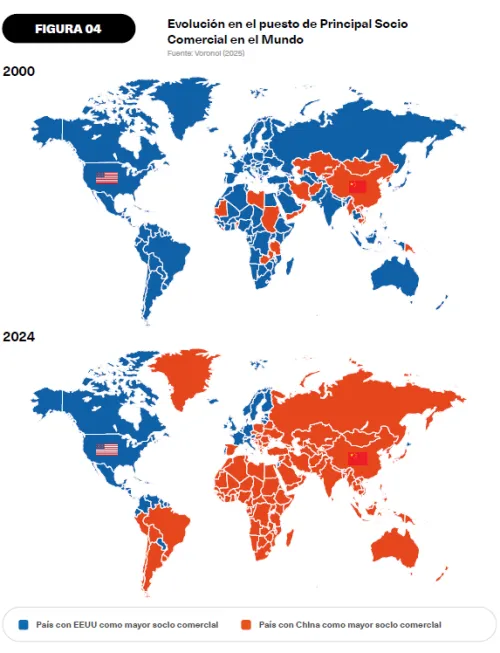
We are witnessing a clash between two economic models: one ultra-liberal, with Argentina and the United States as clear examples, and the other decidedly interventionist, with Russia and China as its leading exponents. These countries, together with Brazil, India and China, form the so-called BRICS, the most powerful alliance in the world, with overwhelming figures that put the ageing Western economies and populations to shame. Together, these countries represent more than a third of the world's population; they are the fastest-growing economies with the brightest future and have the largest energy and mineral reserves; they are also powerful generators of advanced technology. [Figure 04].
"If these countries agreed on everything, the world would have to follow their lead; but that’s not the case, and the other powers will do everything they can to ensure it stays that way," says Eduardo Irastorza.
China is now the preferred trading partner of the largest number of countries on Earth. It has the largest commercial fleet and a comprehensive network of strategic enclaves to control traffic on both its Silk Road and Pearl Necklace routes.
The United States is aware that its position as a hegemonic power is under threat and will defend it at all costs. This is the real reason behind its interventions in different parts of the world. In Latin America, with the arrest of Nicolás Maduro in Venezuela, its interference in Mexican politics and its economic support for Argentina, all in pursuit of the oil, gas and rare minerals that are so vital to its reconquest of markets.
Europe, for its part, is considered by President Trump to be his vassal, and he takes advantage of the disunity among its members in such important areas as armament and trade blockades. Denmark is currently in the firing line because of its sovereignty over Greenland, an island that is vital to the US, China and Russia not only because of its enormous resources but also because of its strategic position on the Arctic route, which they want to open up to save merchant ships thousands of kilometres. Russia has twenty nuclear icebreakers capable of doing this; the United States has only one. The rest of Europe is practically non-existent for Trump. France has reduced its international influence to practically nothing despite its traditional sense of self-sufficiency, and it would not be surprising if the United States wanted to take over the few South Pacific islands it still possesses. Hungary, along with other Eastern European countries, is increasingly defying the West and speaking directly to the US president. And Ukraine could serve as a bargaining chip for the US when it comes to securing Russia's support in the event of a possible confrontation with China.
In the Middle East, the closure of the Strait of Hormuz due to the war in Iran will cause oil shortages in the West (20% of world production passes through it) and therefore an increase in prices, which is already happening. In these circumstances, the US seeks to control all remaining production, including that of Venezuela, and determine prices worldwide. In addition, it will force transactions to be carried out in dollars. And turning to the Far East, the United States continues to use Taiwan as its large aircraft carrier in the South China Sea, but knows that sooner or later it will have to give in to Xi Jinping's demands. However, this will not happen before it has achieved its own autonomy in chip production. The potential conflict with China is now much further north, in the Arctic, and also much further south, in Myanmar.
From war 1.0 to war 2.0
Traditional military wars no longer exist. Today's battles take place mainly in the economic arena, terrorism, cyberspace and the manipulation of public opinion. The goal is to bring about the collapse of the enemy at all levels: the destruction of their weapons, the destruction of their economy, the disappearance of their money, the paralysis of all their structures, the depletion of their energy supplies... and all this is just a click away. Why break something valuable that could be yours? Why steal funds when you can transfer them? Why kill people when you can bring them to their knees?
Military spending on cyberspace has skyrocketed over the last decade and is growing exponentially. In fact, it is the fastest-growing item on the budget. There have even been attempts to test the collapse of international stock markets. A few years ago, Israel destroyed all of Iran's uranium centrifuges with a cyberattack. It simply jammed them with a Trojan horse, without even leaving its chair. Virtual warfare is definitely the future, and the vast majority of us are not prepared for it.
In this new and difficult context, companies such as Musk's X, Thiel's Palantir, Gates' Microsoft and Bezos' Amazon are the ones sustaining the financial markets and reaping the biggest profits. These figures possess information on absolutely everyone and view legality as a line of defence intended to protect those who do not understand “their extraordinary mission”. For the moment, Trump is playing along with them, but he views their intentions with suspicion.