AI and Sustainability: Ethical and Business Challenges and the Impact on Human Capital
Top-level experts discuss how to use AI with purpose in this roundtable hosted by OBS Business School
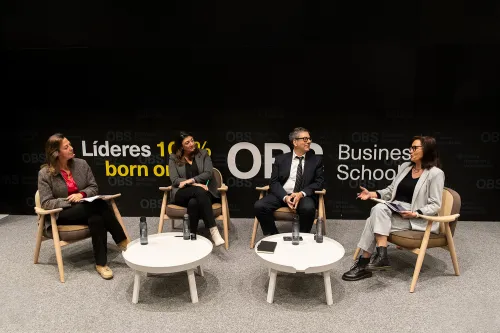
Last Tuesday, 2 December, a roundtable entitled “AI and Sustainability: Ethical and Business Challenges and the Impact on Human Capital” was held at the Planeta Formación y Universidades Auditorium, organised by the School’s Research Department and led by our Dean, Dr Casilda Güell.
For this special event, which was broadcast live on our YouTube channel, we were joined by three top-level speakers who shared their knowledge and experience with the audience:
- Dr Eva Vidal, Senior Lecturer at the Universitat Politècnica de Catalunya.
- Beatriz Bayo, Director of Sustainability and CSR at Proden Group.
- Dr Josep Lluís Bosch, Director of the Master in Human Resources Management and Talent Development at OBS Business School.
The session explored the ethical and business challenges posed by Artificial Intelligence in both the private and public sectors, as well as its direct impact on organisational methodologies, sustainability and human capital management.
AI as a tool for sustainability
At the start of the round table, it was highlighted that Artificial Intelligence has already become a key tool for promoting sustainability. In which areas is this most evident?
- Greater visibility and transparency, especially in data management and KPIs.
- Fact-based decision-making, thanks to accurate and reliable data instead of mere extrapolations.
- Enhanced traceability, through the EU Green Deal’s Digital Product Passport.
The discussion also addressed the associated risks, such as excessive reliance on algorithms and the delegation of critical decisions, which raise questions about AI’s accountability and margin of error. The speakers agreed that true success in its use lies in asking the right questions, following a structured logical approach, and avoiding the attribution of automatic or infallible solutions to the technology. They also highlighted that:
"It is essential to have robust governance and ethical standards to ensure the responsible and appropriate use of Artificial Intelligence."
From Material Impact to Ethical Governance
Although immaterial in its use, Artificial Intelligence has an undeniable physical footprint. We are still assessing its true cost: massive consumption of water and energy, combined with the extraction of materials in vulnerable regions, leading to significant environmental and human impacts.
However, this challenge coexists with a transformative opportunity. As Dr Josep Lluís Bosch pointed out, we are facing a paradigm shift. AI now handles the management of vast volumes of information, freeing humans to elevate their role: preparing, interpreting, and focusing the data.
"Technology then becomes a support for creativity and decision-making, but never a substitute for critical thinking."
After the discussion, the speakers agreed that AI integration should be guided by three fundamental pillars to enhance sustainability without compromising ethics:
- Ethics by design and governance: Ethics cannot be an afterthought; it must be a structural component from the outset. Corporate responses should align with CSR, reviewing how sustainability KPIs evolve in the era of generative AI.
- AI as an ESG catalyst: When used with transparency as a guiding principle, AI can steer business towards data-driven decision-making, accurately identifying risks and opportunities. This enhances the quality and credibility of sustainability reporting.
- Human autonomy and positive regulation: It is vital to ensure that technology does not override human agency.
As Dr Eva Vidal said before the round table ended, it is crucial that regulation is not seen as a brake on innovation, but as a guide to ensuring responsible use, aligned with human rights and corporate objectives.